Every year, between April and May, Italy reaches a milestone that nobody would want to celebrate: its Overshoot Day, the day on which our country has already used up all the natural resources that the Earth can regenerate over the course of a whole year. From that moment onwards, we are in debt to the planet.
If you’re wondering what Overshoot Day means, when it falls in Italy, or how many Earths we consume, you’ve come to the right place. In this article, you’ll find a comprehensive answer, with a year-by-year historical comparison and concrete steps you can take — even you, today.
What is Overshoot Day? Meaning and definition
Overshoot Day is the date on which humanity — or a single country — has consumed all the biological resources that the Earth is capable of regenerating in the course of that year. Once this threshold is crossed, we enter an ecological deficit: we draw on resources that belong to future years, taking them away from future generations.
It is calculated annually by the Global Footprint Network,, an international research organisation. The method is based on two factors:
Ecological footprint: the amount of land and water area required for one person to produce everything they consume (food, energy, fibre, timber) and to absorb the waste and CO₂ emissions they generate.
Global biocapacity: the Earth’s capacity to regenerate its natural resources each year.
The formula is simple: divide biocapacity by the ecological footprint and multiply by the 365 days of the year. The result is the date of Overshoot Day. There are two types of Overshoot Day:
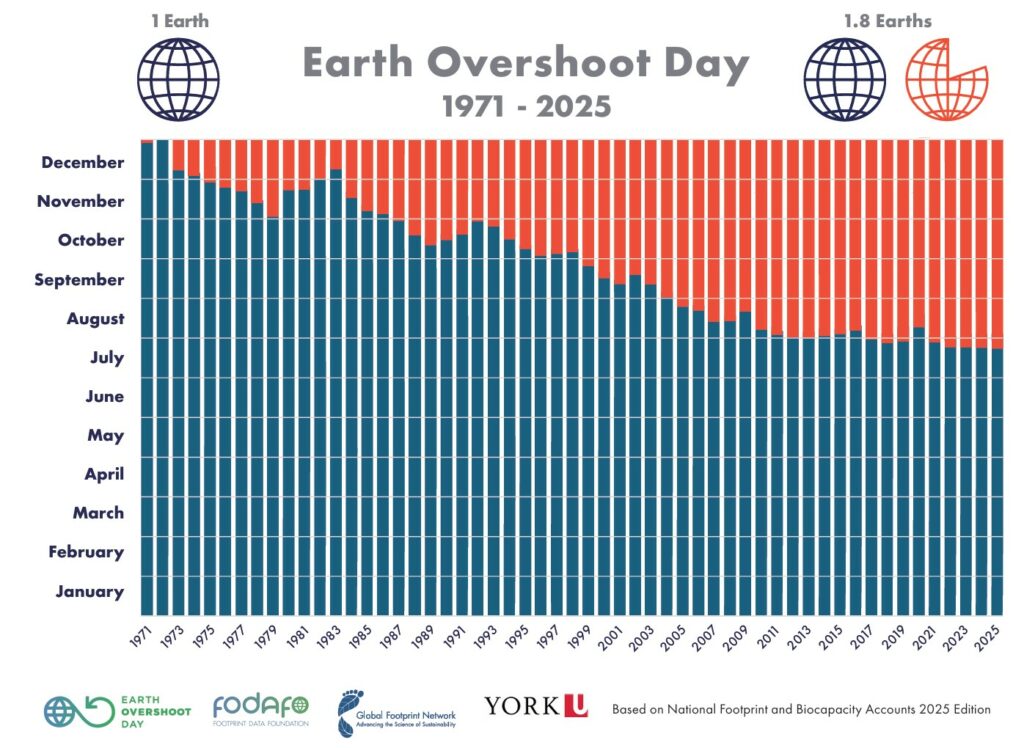
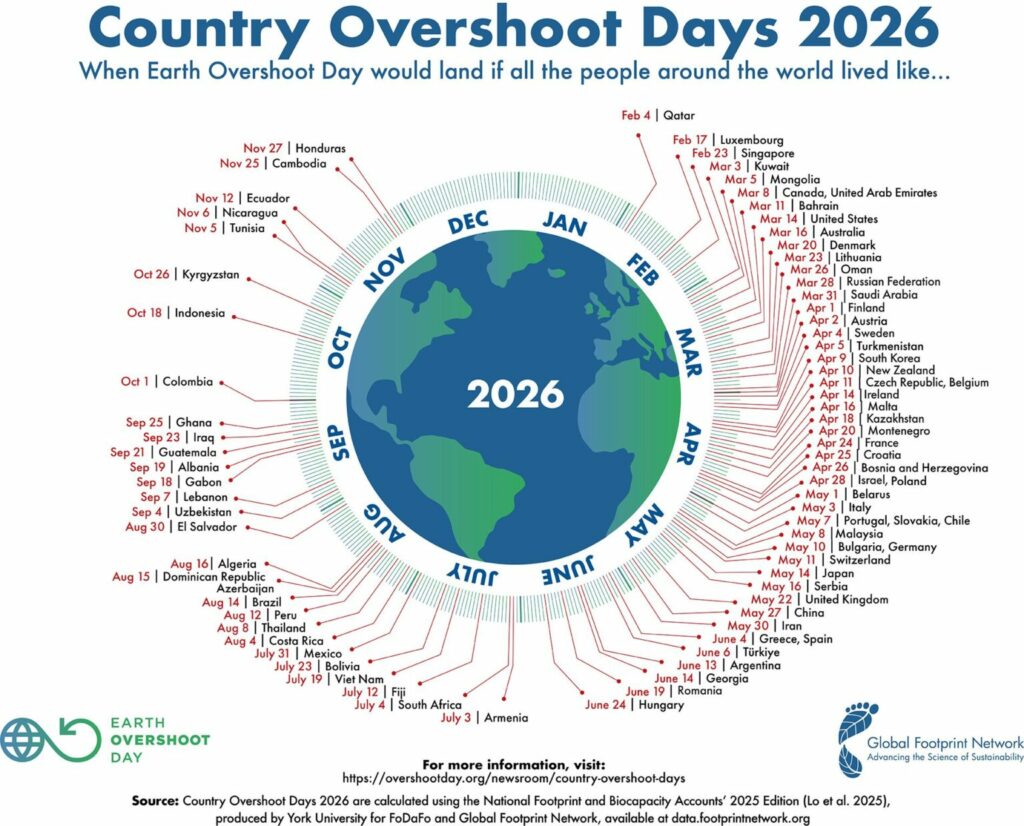
Earth Overshoot Day → the global date for all of humanity (in 2025 it fell on 24 July). Country Overshoot Day → the specific date for each individual country, calculated as if the whole of humanity lived according to that nation’s consumption patterns.
When is Earth Overshoot Day in Italy?
Italy reaches its Earth Overshoot Day between late April and mid-May, with slight variations from year to year. If all 8 billion people on Earth consumed resources at the same rate as Italians, the planet would have exhausted its annual ecological budget by the first half of the year.
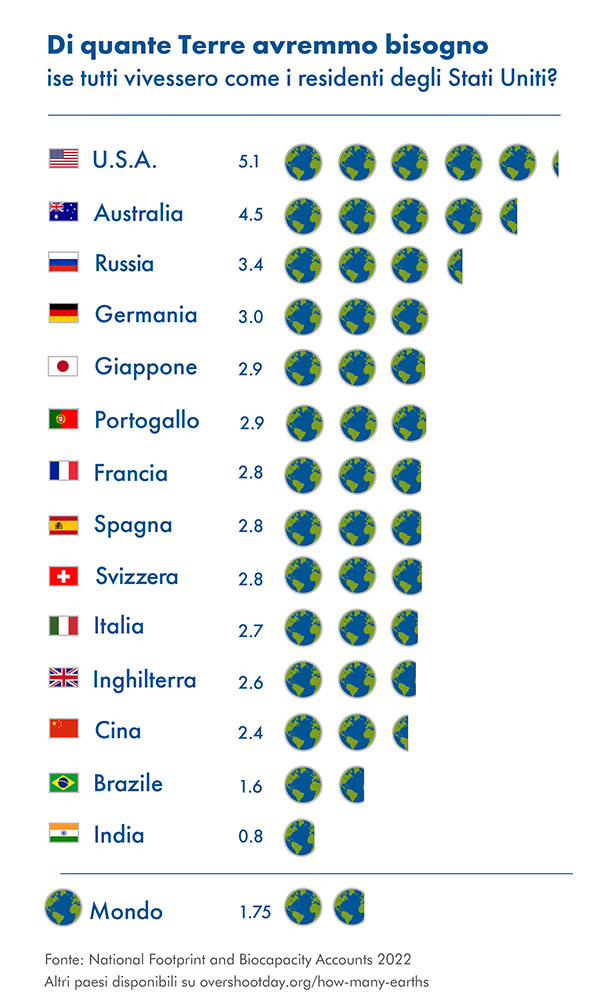
This means that Italy requires the equivalent of around 3 Earths to sustain its lifestyle. To put it even more bluntly: it would take more than 5 ‘Italies’ in terms of land area to meet the demand for natural resources of Italian residents — a figure that firmly places us among the countries with the heaviest ecological footprint in Europe.
You can find the updated date each year in the historical section below.
The evolution of Overshoot Day in Italy: a historical overview
In recent years, the date for Italy has fluctuated, partly due to methodological revisions in the Global Footprint Network’s data. Here is the updated overview:
Italy’s Overshoot Day 2021: 13 May
Similar to 2020; the post-pandemic effect is still evident.
Italy’s Overshoot Day 2022: 15 May
A slight improvement compared to 2021.
Italy’s Overshoot Day 2023: 15 May
Stable, but already in deficit halfway through the year.
Italy’s Overshoot Day 2024: 19 May
An apparent improvement, partly linked to data revisions.
Italy’s Overshoot Day 2025: 6 May
13 days earlier than in 2024, partly due to new data on agricultural soils and the marine carbon budget.
Italy’s Overshoot Day 2026: 3 May
Further advance: Italy requires approximately 3 Earths.
What does this trend tell us? The date has stabilised — and in some years moved forward — to around the first few days of May. The ‘jump’ between 2024 and 2025 is not solely the result of increased consumption: the methodological revision in 2025 updated data on agricultural land and ocean carbon sequestration, shifting the dates for many countries. However, the underlying trend remains worrying: for years, Italy has consistently exceeded the sustainability threshold by the first half of the year.
How does Italy compare in a global and European context?
To understand the situation in Italy, it is worth taking a look around. For reference, here is how the dates break down for the main countries (2026 data):
Qatar: 4 February — the country with the highest consumption
United States: 14 March
France: 24 April
European Union (average): 3 May
Italy: 3 May — in line with the EU average
Spain: 4 June
Earth Overshoot Day (global): July–August (varies each year)
Italy ranks in the middle of the pack among European countries: generally better than France and the countries of Northern Europe, but still far from sustainable.
How many Earths does Italy consume?
According to data from the National Footprint and Biocapacity Accounts, Italy’s per capita ecological footprint translates to a requirement of around 3 Earths if the entire human population lived as we do. In terms of national territory, more than 5 Italies would be needed to meet the resource demands of Italian residents alone. The factors that weigh most heavily on Italy’s ecological footprint are:
The carbon footprint (fossil fuel emissions): accounts for 61% of the global ecological footprint
Food consumption, particularly animal proteins
Private transport and air travel
Land use and infrastructure
What happens after Overshoot Day?
After 3 May, Italy — like all countries in overshoot — begins to draw on the ‘ecological bank account’ of future years. In practice:
Deforestation continues to meet the demand for timber and agricultural land without allowing sufficient time for regeneration.
Fish stocks are depleted at a rate exceeding natural recovery.
CO₂ accumulates in the atmosphere faster than forests and oceans can absorb it.
Biodiversity is degraded and the ability of ecosystems to regenerate is compromised.
The ecological debt accumulated by humanity from the early 1970s to 2026 is equivalent to 22 years of the Earth’s full biological productivity — a burden we are bequeathing to future generations.
What can you do? Practical steps to reduce your ecological footprint
The good news is that solutions do exist, and many are within everyone’s reach. Every individual choice, multiplied by millions of people, makes a real difference.
Diet Reducing meat consumption (especially beef) is one of the most effective actions: livestock production is responsible for a huge proportion of emissions and land use. Choosing local and seasonal produce, reducing food waste and opting for a diet rich in pulses and vegetables can push back your personal Overshoot Day by weeks.
Mobility Using public transport, cycling or walking for short journeys, and reducing intercontinental flights: these behaviours have a significant impact on your individual carbon footprint.
Home and energy Switching to a renewable energy supplier, improving your home’s thermal insulation, choosing energy-efficient appliances, and reducing heating and cooling consumption are measures with lasting effects.
Consumption Buy less and buy better, opt for second-hand items, repair rather than replace, and avoid fast fashion: every manufactured item has an ecological cost that begins long before it reaches our hands.
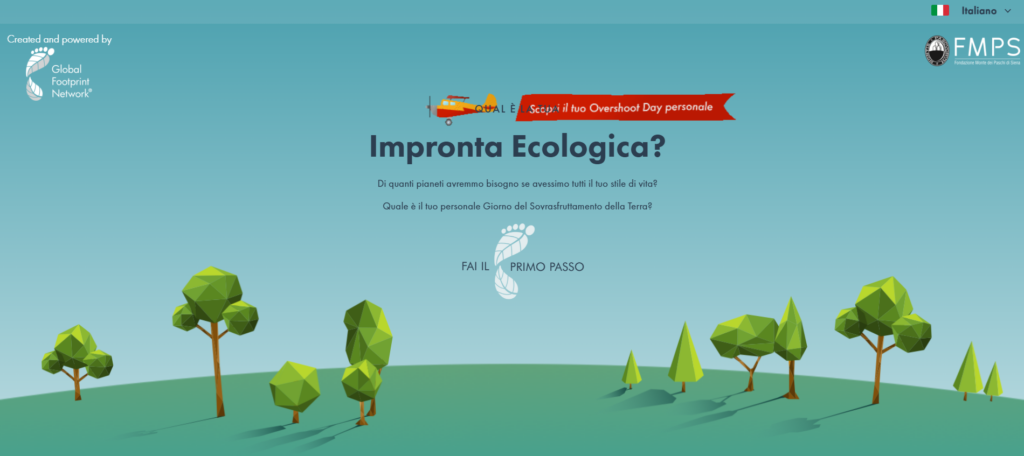
Calculate your personal Overshoot Day The Global Footprint Network offers a free test on footprintcalculator.org to find out when your personal Overshoot Day would fall. It’s an excellent starting point for understanding where to take action.
How WOWnature can help you take action
At WOWnature, we believe that every tree planted is a tangible act of giving back to the Earth. Forests are one of the few natural systems capable of absorbing CO₂, protecting biodiversity, regulating the water cycle and maintaining fertile soil — everything needed to keep overshoot at bay.
By adopting a tree with WOWnature, you directly support our reforestation projects in Italy, helping to reduce the country’s ecological deficit. It is not about offsetting, but about regenerating: every forest that grows is biocapacity made available again.